



How a Roof Spray Test Pinpointed a Hidden Leak in a Sydney Home
July 7, 2026 12:18 pmWhen a homeowner in Sydney noticed damp patches appearing on their interior walls after heavy rain, they suspected a roof leak — but pinpointing the exact source is rarely straightforward. That’s where Evolution Plumbing’s professional roof spray test comes in.
Using a controlled water spray test combined with FLIR thermal imaging, our licensed plumbers confirmed the precise point of water ingress at the roof flashing and penetrations — and documented every step of the process.
What Is a Roof Spray Test?
A roof spray test (also called a hose test or water intrusion test) is a systematic diagnostic method used by licensed plumbers and leak detection specialists to simulate rainfall and isolate where water is entering a building.
Rather than guessing, technicians methodically wet specific areas of the roof — starting from the lowest point and working upward — while a second operator monitors the interior for signs of moisture. This controlled approach eliminates guesswork and saves homeowners the cost of unnecessary repairs.
Key Areas We Target in a Spray Test
- Roof flashing — the metal strips sealing joins between the roof and walls, skylights, or chimneys
- Roof penetrations — pipes, vents, exhaust fans, and conduits that pass through the roof membrane
- Ridge and hip cappings
- Valley gutters and box gutters
- Parapet walls and their associated flashings
What We Found: Flashing & Penetration Failure
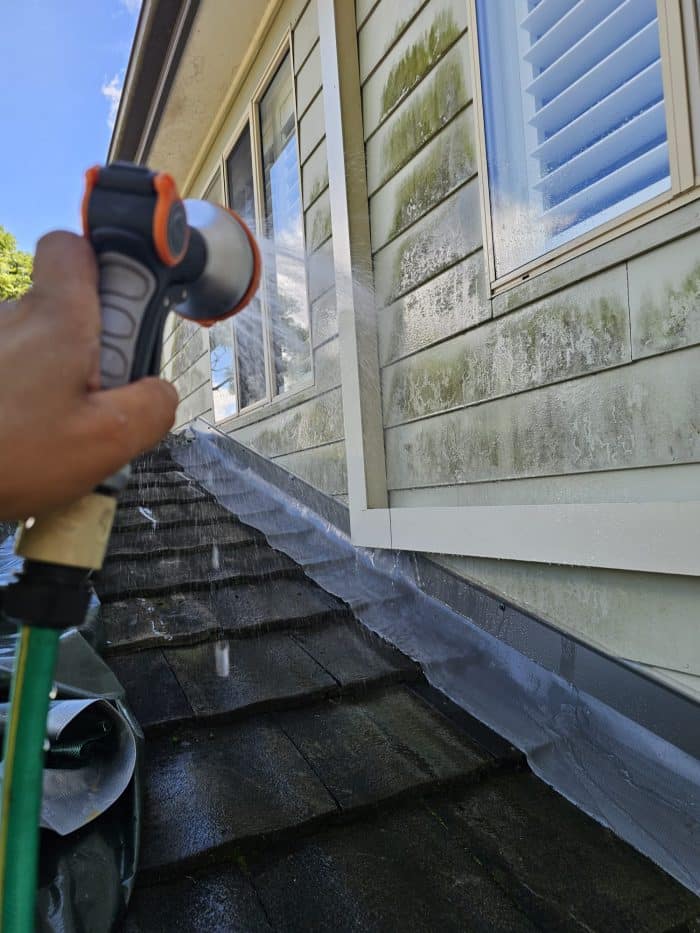
In this job, our technician directed the spray hose at the roof flashing and the surrounding penetration points. Within minutes, the interior operator confirmed moisture breakthrough — pinpointing the water ingress point with certainty.
The images above tell the full story:
- Significant algae and moss growth on the external cladding — a classic visual indicator of chronic moisture intrusion
- Water tracking down the wall cladding at the flashing junction, confirming the seal had failed
- The point of entry was definitively confirmed before any repair work commenced
Thermal Imaging: Seeing the Invisible with FLIR E75
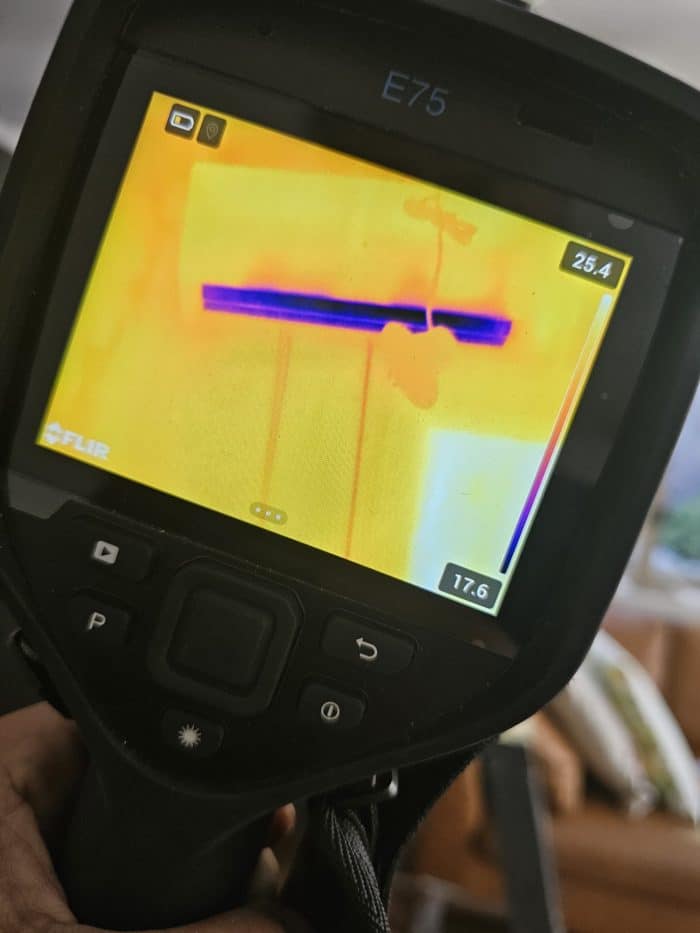
Once the spray test confirmed water ingress, our technician deployed the FLIR E75 thermal imaging camera — a professional-grade infrared tool used extensively in building diagnostics.
The thermal scan revealed exactly what the naked eye cannot see:
- A sharp, horizontal cold band (displayed in dark blue/purple) running across the wall surface — the thermal signature of moisture trapped within the building structure
- Surrounding areas showing normal ambient temperature (yellow/orange tones), confirming the moisture is isolated to the flashing/penetration zone
- Temperature differential of approximately 7.8°C between wet and dry zones — well above the threshold for confident moisture identification
Why Confirm Before You Repair?
Many Sydney homeowners have paid for roof repairs that didn’t solve the problem — because the actual leak source was never confirmed before work began. The spray test and thermal scan combination eliminates this risk by:
- Identifying the exact water entry point before any tiles are lifted or materials replaced
- Providing photographic and thermal evidence for insurance claims or builder disputes
- Preventing unnecessary repair costs on areas that aren’t leaking
- Giving homeowners documented proof of the defect — important for new builds or warranty claims
Evolution Plumbing’s Roof Leak Detection Process
Here’s how our end-to-end leak detection service works:
- Initial site inspection — visual assessment of roof, flashings, gutters, and cladding
- Roof spray test — systematic hose test targeting flashings and penetrations
- FLIR thermal imaging scan — non-destructive moisture confirmation inside walls
- Written report with photos and thermal images
- Repair recommendation and quote
Categorised in: News
This post was written by EVS Admin
Comments are closed here.